

2025-10-31

Firstly, introduce the type of equipment or vehicle, usage scenarios, installation location, and current issues that need to be addressed. For example, whether to search for matching charging equipment for a new project or to replace an existing solution; What aspects of existing products cannot meet the demand. If there are system diagrams, on-site photos, or current equipment information, they can be provided as attachments to help both parties establish a common understanding of the project.
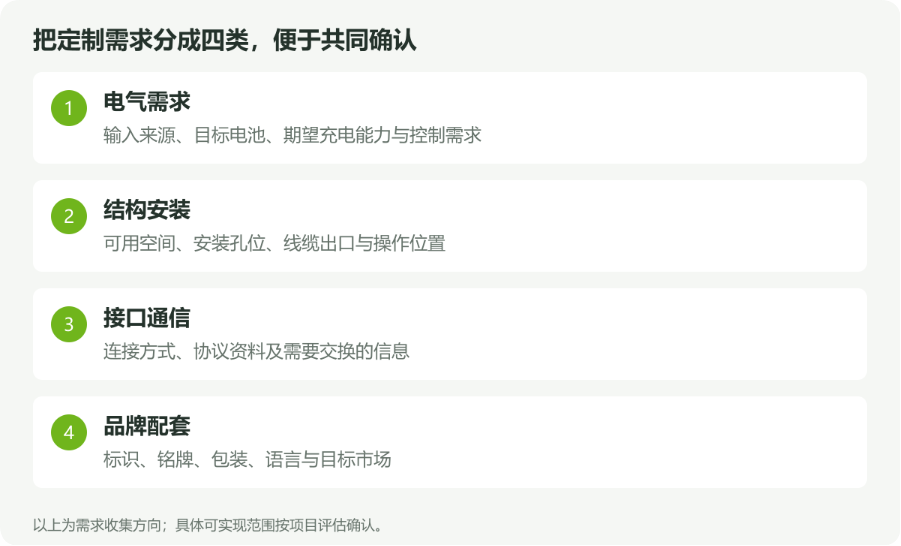
Suggest providing input sources and ranges, target battery information, expected charging capacity, and control requirements. When multiple power sources or batteries are involved, their respective uses and connection relationships should be explained for temporarily uncertain parameters. Battery and machine manuals can be attached, and the expected usage effect should be explained. Both parties can further confirm the feasible configuration.
3、 Distinguish between requirements that must be met and those that can be adjusted
List the external space, installation holes, cable outlets, interfaces, and operating methods separately, and mark which conditions must be met and which can be negotiated and adjusted. This will help evaluate the possibility of adapting to existing platforms. If there are communication or system linkage requirements, please provide interface specifications, protocol materials, and information to be exchanged; Simply stating 'communication required' is often insufficient to determine the scope of development.
| requirement priority | How to fill in |
|---|---|
| Must meet | Clearly define the limitations and provide evidence or drawings. |
| can be adjusted | Clearly state the negotiable scope to facilitate the evaluation of existing solutions. |
| Not yet determined | Mark as to be evaluated, supplement goals and existing information. |
If there are requirements for brand identity, nameplates, labels, packaging, or instructions, brand documents, language requirements, and target market can be provided. Requirements related to certification, testing, or special delivery documents should also be raised early in the project. The above content is used to define requirements and does not mean that all projects require new development. The specific scope of implementation, data responsibilities, and delivery content need to be confirmed after evaluation.
Before applying for samples, it is recommended to specify the key issues to be verified in this round, such as electrical compatibility, structural installation, operational experience, or system linkage, and explain the testing environment and feedback methods. The problems discovered in the sample should be documented, including testing conditions, phenomena, expected results, and necessary images. Subsequent version adjustments and batch configurations should be based on the results confirmed by both parties.
Figure 2 | First agree on the validation objectives, and then generate traceable sample feedback.
We plan to use the charger for [application devices], with the input source being [power information] and the target battery being [type, nominal voltage, and capacity]. I hope to meet the charging or control requirements, and the available installation space is [size and photo]. It is necessary to evaluate the [interface/structure/brand matching]. Currently in the stage of scheme evaluation/sample validation/batch preparation, the expected quantity and expected time are in the project plan. You can submit your requirements in the above format. The specific plan, sample arrangement, cost and delivery schedule will be confirmed through communication based on the project scope and evaluation results.
Online service consultation


Service Support
Please scan the official official account